Who to Tell When You Move House in Victoria
The boxes are the visible part of a move. The address changes are the part that quietly follows you around for months — a rates notice at the old house, a renewal that never arrives, a rebate paid to the wrong account.
Most of it is straightforward once it’s written down, and a few items have real deadlines attached. This is the Victorian version of that list, with the timeframes that actually apply and the order that makes them easy to work through.
The Short Answer
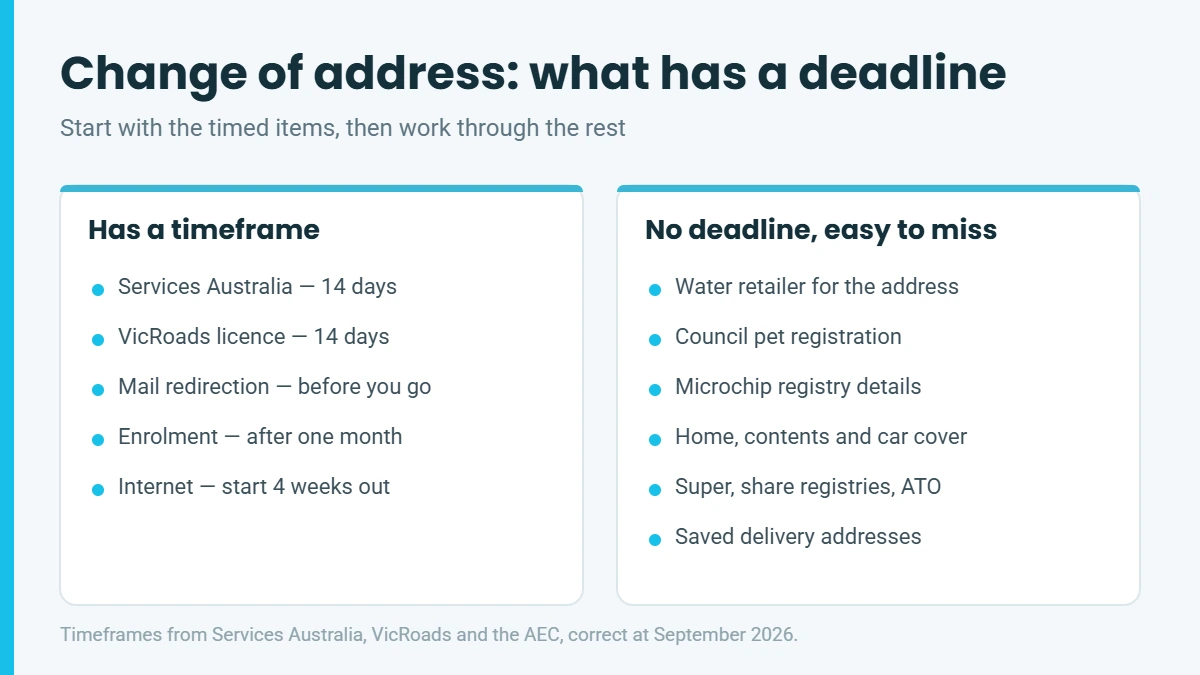
Start with the four that have a timeframe or a lead time, then work outwards.
| Who | When | How |
|---|---|---|
| Services Australia (Centrelink, Medicare, Child Support) | Within 14 days of moving | myGov, or the Express Plus apps |
| VicRoads (driver licence) | Within 14 days of moving | myVicRoads account online |
| Australia Post (mail redirection) | Set it up before you move | Online or at a post office, with ID |
| Electoral enrolment | Once you’ve lived there a month | AEC online form |
Everything after that — banks, insurers, employer, super, subscriptions — has no deadline but plenty of consequences if it’s missed.
The Ones With Deadlines
Services Australia: 14 days
Services Australia asks you to update your address within 14 days, and the requirement applies “even if you don’t get a payment from us”. One update through myGov covers your linked Centrelink, Medicare and Child Support accounts, so it is a single job rather than three.
If you rent and receive payments, updating through myGov is also what triggers a Rent Assistance reassessment, so a delay here can cost you money directly.
VicRoads: 14 days
VicRoads asks licence holders to update their address within 14 days of moving. Do it through your myVicRoads account, and while you are in there, check that the address held against your vehicle registration is right too. Registration renewals and toll or infringement notices go to the address on file, and “it went to the old house” is not a defence that helps anyone.
Electoral enrolment
The AEC’s rule is a residency one: you are eligible to enrol at your new address once you have lived there for at least one month. Update it online when that month is up. In Victoria the same update flows through to the state roll, so you don’t need to lodge it twice.
Mail redirection
Redirection is the safety net for everything you forget. Australia Post offers redirection in periods of 1, 3, 6 or 12 months, you need proof of identity, and you can include up to six names on the one application — worth doing for everyone in the household rather than just the person who signed the lease.
Three months is the usual sweet spot: long enough to catch annual notices you’ve forgotten, short enough that you are forced to finish the job. Set it up a week or two before the move so it is live from the day you hand the keys back.
Utilities and Connections
These need the most lead time, and they’re the ones that hurt on day one if they’re wrong.
- Electricity and gas. Tell your retailer you are moving, give them a final meter read date at the old address and a connection date at the new one. This is also the natural moment to compare offers, since you are changing the account anyway.
- Water. In metropolitan Melbourne your water retailer is set by your address rather than chosen — Greater Western Water, South East Water or Yarra Valley Water — so a move across town can mean a different retailer entirely. Contact the one that covers the new address to open an account, and the old one to close yours.
- Internet. Start this first. Moving an existing connection can take days, and a new connection at an address that has never had one can take considerably longer. Check what technology the new address has before you assume your current plan carries over.
- Meter access. If the meter at either property is behind a locked gate or inside, arrange access for the final read.
Victorian Details People Miss
Council. You’ll be moving from one council’s rates and services to another’s. If you own, the rates notice follows the property title, but bin sizes, hard waste collection and parking permit eligibility all reset. Check the new council’s hard rubbish rules early — it is the cheapest way to deal with what you don’t want to move.
Pets. Dogs and cats have to be registered with the council they live in under the Domestic Animals Act 1994, and fines apply for not complying. Moving into a new council area means registering with that council. Update the microchip registry with your new address and phone number at the same time — that is the record that gets your pet home if they bolt in the first week, which is exactly when they’re most likely to.
Schools and childcare. Enrolment and transfers take time, and a new address can change which school zone you fall into.
Health. Update Medicare through myGov, and ask your GP, specialists, dentist and pharmacy to update their records. If you’re moving far enough to change practices, request a copy of your records rather than assuming they’ll transfer.
Money, Work and Insurance
- Banks, credit cards and loans — new cards and statements go to the address on file
- Home and contents insurance — your premium is tied to the address, so this one has to change before you move in, not after; check whether cover applies while your goods are in transit and ask your removalist what applies on their side
- Car insurance — where the car is parked overnight affects the policy
- Health insurance — some extras and policies are state-based
- Superannuation and share registries — easy to forget and awkward to fix years later
- Employer and payroll — payslips, tax documents and sometimes allowances
- ATO — through myGov, along with everything else linked there
- Accountant, solicitor and the Titles Office if you own the property
The Everyday Accounts
None of these are urgent. All of them turn up eventually.
- Online shopping and delivery accounts, including saved default addresses
- Food delivery and rideshare apps
- Streaming and subscription boxes
- Gym, library, clubs and memberships
- Vet, groomer and pet insurance
- Roadside assistance
- Charities you give to regularly
- Family and friends, which is easier as one message than twenty
A practical trick: for the first three months, every piece of redirected mail that arrives is a to-do item. Whoever sent it hasn’t been updated yet.
If You’re Renting
A rental move has its own paperwork on top of the address changes — notice periods, the condition report and the bond. Those are set by Victorian residential tenancy law rather than by your removalist, and Consumer Affairs Victoria is the authority to check for what applies to your situation and your dates. Two things worth doing regardless: take photographs at both properties before anything is moved in or out, and don’t book the truck for a date you haven’t confirmed in writing.
A Timeline That Works
- Four weeks out — book the removalist, start the internet connection, tell your energy retailer and check the new address’s water retailer
- Two weeks out — set up mail redirection, notify insurers, update your employer and payroll
- One week out — confirm connection and disconnection dates, arrange meter access, book the final clean if you’re renting
- Moving week — take meter readings and photographs at the old property, confirm the truck and any building or parking bookings
- First fortnight — myGov and Services Australia, VicRoads, banks, council pet registration
- After a month — electoral enrolment, then work through whatever the redirected mail is still turning up
Frequently Asked Questions
How long do I have to change my address after moving in Victoria?
Services Australia asks for the update within 14 days of moving, even if you don’t receive a payment, and VicRoads asks licence holders to update within 14 days. Electoral enrolment works differently: you become eligible to enrol at the new address once you’ve lived there for a month.
Does one update change everything on myGov?
Updating your address in myGov flows through to the services linked to it, such as Centrelink, Medicare and the ATO. It does not reach VicRoads, your bank, your insurer or your utilities — those are separate.
How much does mail redirection cost and how long should I set it for?
Australia Post charges by period, with options of 1, 3, 6 or 12 months and current pricing on its website. Three months covers most quarterly notices and gives you time to finish updating accounts; 12 months suits anyone expecting annual statements or moving during a busy year.
Do I need to tell the council I’ve moved?
If you own the property, rates follow the title, so the councils sort that out between them. What you do need to handle yourself is pet registration with the new council, and checking the new council’s bin and hard waste arrangements.
When should I organise the internet connection?
As early as you can, ideally four weeks out. Transferring a service takes days, and a new connection at an address that has never had one can take longer again, particularly in new estates.
What should I do about my address the day I move?
Take final meter readings and photographs at the old property, make sure mail redirection is already active, and keep documents, keys and medication with you rather than on the truck.
Planning a Move in Melbourne or Victoria?
Tell us the two addresses, the date and what is coming with you, and we will send a written quote. Request a quote online, contact our team or call 0470 515 895. You can also see how house removals work with us, read what a move costs in Melbourne, or find out about packing and unpacking.