Removalist Parking Permits and Building Access in Melbourne
A move runs late for one of two reasons far more often than any other: the truck had nowhere legal to stop, or the building wouldn’t release the lift. Both are solvable, and both have to be sorted out a week or two before moving day rather than on the morning.
This guide covers when you need a council parking permit in Melbourne, what four inner councils actually charge and how much notice they want, and what apartment buildings will ask for before they let a removal crew start.
The Short Answer
You need a council permit whenever the truck has to occupy a public parking bay, a metered bay or a restricted zone for the length of the move, and there is no driveway, loading dock or off-street space that works instead.
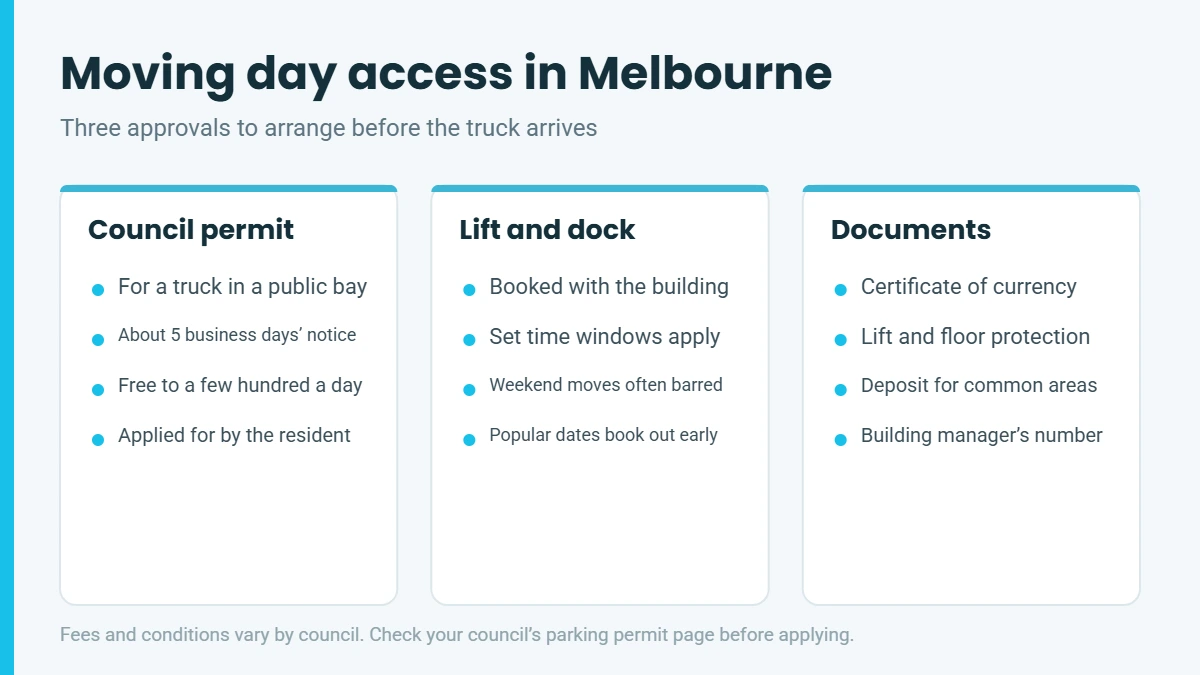
Inner-Melbourne councils all run a version of this permit, they mostly want five business days’ notice, and the cost ranges from free to a few hundred dollars a day depending on the council and the street. Apartment buildings are a separate approval again: the lift booking goes through the building manager or owners corporation, not the council.
In most outer and middle suburbs with a driveway and unrestricted street parking, you need neither.
When You Actually Need a Permit
Work through it in this order.
- Is there off-street space? A driveway, a loading dock or a private car park that a truck can physically get into usually removes the problem entirely. Check the height clearance before assuming — many basement car parks are under 2.2 metres and no removal truck fits.
- What do the signs say? Photograph the signs directly outside both addresses. Two-hour metered parking, permit zones, clearways and no-stopping in peak hours all matter, and so does the clearway time on main roads.
- How long will the truck be there? A two-bedroom unit might take three hours at each end. A four-bedroom house is most of a day. A two-hour bay doesn’t cover either.
- Is it a tram route or a narrow street? On a tram route or a single-lane street with cars parked both sides, a truck that simply double-parks blocks traffic and will be moved on.
If you get to the end of that list and the truck has nowhere legal to stand for the time the job needs, apply for the permit.
What Four Inner Melbourne Councils Require
Every council runs its own scheme under its own name, which is the main reason people get confused. Fees and conditions below were current in September 2026 — check the council’s own page before you apply, because they change with each council’s annual fee schedule.
| Council | Permit | Notice | Cost |
|---|---|---|---|
| City of Melbourne CBD, Docklands, Carlton, North Melbourne, Southbank | Reserved parking permit — removalists are a listed use | Five clear business days | $206 per day for the first bay, $103 per day for each extra bay. Residents moving in or out of their own home get 50% off with a utility bill or lease |
| City of Yarra Fitzroy, Collingwood, Richmond, Abbotsford | Parking bay occupation — moving house is a listed reason | At least five business days | Non-metered street $87.95 first day, then $46 per day. Metered street $135 first day, then $79 per day |
| City of Port Phillip St Kilda, South Melbourne, Port Melbourne, Elwood | Temporary parking permit — covers resident relocation | At least five business days | Free for resident relocation, up to three days |
| City of Stonnington South Yarra, Prahran, Windsor, Armadale, Malvern | Temporary permit for short-term access to your home, rather than a dedicated removalist permit | Applied for by phone or in person | Up to 30 days in a calendar year; call 03 8290 1333 to confirm what applies to your address |
Sources: City of Melbourne, City of Yarra, City of Port Phillip, City of Stonnington.
Other councils — Merri-bek, Darebin, Moonee Valley, Maribyrnong, Boroondara, Glen Eira — run comparable schemes under names like temporary parking permit, works permit or road occupation permit. Search your council’s site for “parking permit” and look for the short-term or temporary category.
How the Application Works
The City of Melbourne process is the most involved of the four and a good guide to what any council will want.
- Look at the street in person and note how the bays are arranged. You will be asked for a photograph of the location.
- Complete the application form with the address, the dates and the number of bays. Bookings can start from 5am.
- Submit it more than five clear business days ahead, allowing for weekends and public holidays. Permits are not issued on the spot.
- Pay when they contact you. City of Melbourne requires payment to be receipted by 10am on the business day before the booking.
- Print the permit and display it on the dashboard so it is legible from outside the vehicle.
One detail worth knowing: a permit doesn’t always mean the council changes the signs. Where signage can’t be altered, you get a self-managed location — you find a permissive bay, park, display the permit, and you are allowed to use bollards or witches hats to hold the bay you were issued. Where signs can be changed, they’ll read “No Stopping, Reserved Parking Permit Holders Excepted”.
If you arrive and the reserved bays are occupied or the signs never went up, City of Melbourne’s instruction is to park in the nearest permissive bay, display the permit and call 9658 9658 with your permit number.
How Many Bays to Book
A removal truck is longer than a car and needs room to work the tail lift, so one bay is rarely enough. Two to three consecutive bays is the usual request for a household move; a larger truck on a busy street can need more. Ask your removalist what size truck is coming before you fill in the form, because the answer changes what you book and what you pay.
Apartment Buildings: the Second Approval
In a Melbourne apartment, the council permit is only half the job. The building has its own rules, and they are enforced by the building manager or owners corporation.
- Lift bookings. Most buildings require the service lift to be booked, often in a set window such as 8am to 12pm, and many don’t allow moves on weekends or public holidays at all. Popular end-of-month dates go early.
- Loading dock or bay. Where there is one, it usually has a height limit and a time limit, and it may need booking separately from the lift.
- Certificate of currency. Many buildings want the removalist’s public liability certificate on file before they’ll release the lift. Ask your removalist for it as soon as the building asks.
- Protection. Buildings commonly require lift blankets, corner guards or floor protection, and a bond or deposit against damage to common property.
- Access after hours. If the move runs past the booked window, find out in advance who you call.
Ring the building manager at both ends as soon as your date is confirmed. The two questions that matter are: what do I have to book, and what do you need from my removalist?
Melbourne Streets That Need Extra Thought
Inner-north and inner-east terraces. Single-file streets in Fitzroy, Carlton, Richmond and North Melbourne with cars both sides leave no room for a truck to sit. A permit that holds the bays directly outside is what makes the job possible at all.
Laneways and rear access. A rear laneway is often the better option, but many are too narrow for a large truck to turn. A smaller truck doing two trips can beat a large truck that can’t get in.
Tram routes and clearways. On Sydney Road, Chapel Street, Swan Street and similar, clearway hours make kerbside loading impossible for parts of the day. Plan the start time around the clearway, not the other way round.
High-rise CBD and Southbank towers. Expect a booked dock, a booked lift, a certificate of currency and a strict window.
Steep driveways in the east. In suburbs around the Dandenongs, a truck that can’t safely reverse up a steep or unsealed drive means a longer carry, which is worth knowing before quoting day.
A Simple Timeline
- Three to four weeks out — confirm the date, then call the building manager at both ends and ask what has to be booked
- Two weeks out — photograph the signs at both addresses, work out whether you need a permit, and apply
- One week out — confirm the lift booking, send the certificate of currency to the building, and pay for the permit
- The day before — print the permit, and let neighbours know the truck will be there
- On the day — display the permit on the dashboard, and have the building manager’s number on your phone
What to Tell Your Removalist
Access is one of the biggest variables in what a move costs, because it decides how far the crew carries and how long the job takes. When we quote a move in Melbourne, the access questions are the ones we ask first: which floor, whether there is a lift and whether it is booked, how far the truck can get from the door, how many stairs, and whether the street is restricted. Tell us the awkward details rather than hoping they won’t matter — a known long carry is a planning problem, an unknown one is a delay.
Frequently Asked Questions
Do I need a permit for a removalist truck in Melbourne?
Only if the truck has to occupy a public parking bay or restricted zone and there is no off-street option. In the City of Melbourne, Yarra and Port Phillip you apply for a short-term permit with about five business days’ notice. In suburbs with a driveway and unrestricted street parking, you generally don’t need one.
How much does a moving truck parking permit cost in Melbourne?
It depends on the council. As at September 2026, City of Melbourne charges $206 per day for the first bay and $103 for each additional bay, with a 50% discount for residents moving in or out of their own home. City of Yarra charges $87.95 for the first day on a non-metered street. City of Port Phillip issues resident relocation permits free for up to three days.
How far in advance do I need to apply?
Five business days is the common requirement, and it means five clear business days — weekends and public holidays don’t count. Applying two weeks out gives you room if the council comes back with questions.
What happens if the truck parks without a permit?
The truck can be fined, and on a clearway or in a no-stopping zone it can be moved on mid-job, which costs you time you’re paying for. If the street genuinely leaves no legal option, the permit is cheaper than the alternative.
Who books the lift in an apartment building?
You do, through the building manager or owners corporation, and usually well before moving day. Your removalist can supply documents the building asks for, such as a certificate of currency, but the booking sits with the resident.
Can a removal truck use a loading zone?
Loading zones have time limits that are usually far shorter than a household move, so they suit a quick drop-off rather than a full move. For a move, a reserved bay or a booked dock is the reliable option.
Moving Somewhere With Tight Access?
Send us the address, the floor and a photo of the street, and we will tell you what the truck can do and send a written quote. Request a quote online, contact our team or call 0470 515 895. You can also see what a house move involves, check what removalists cost in Melbourne, or find your suburb in the areas we serve.