What You Can’t Take When Moving Interstate from Melbourne
Most of a household move crosses a state border without anyone thinking twice about it. A handful of things don’t. Some are refused because no removal truck is allowed to carry them, and some are refused at the other end because of the state’s biosecurity rules.
Both lists are short, and both are much easier to deal with three weeks out than on the morning of the move. This guide covers what a removal truck won’t take out of Melbourne, what the destination states restrict, and what to do with the things that can’t come with you.
The Short Answer
Two groups of items can’t travel in an interstate removal truck from Melbourne.
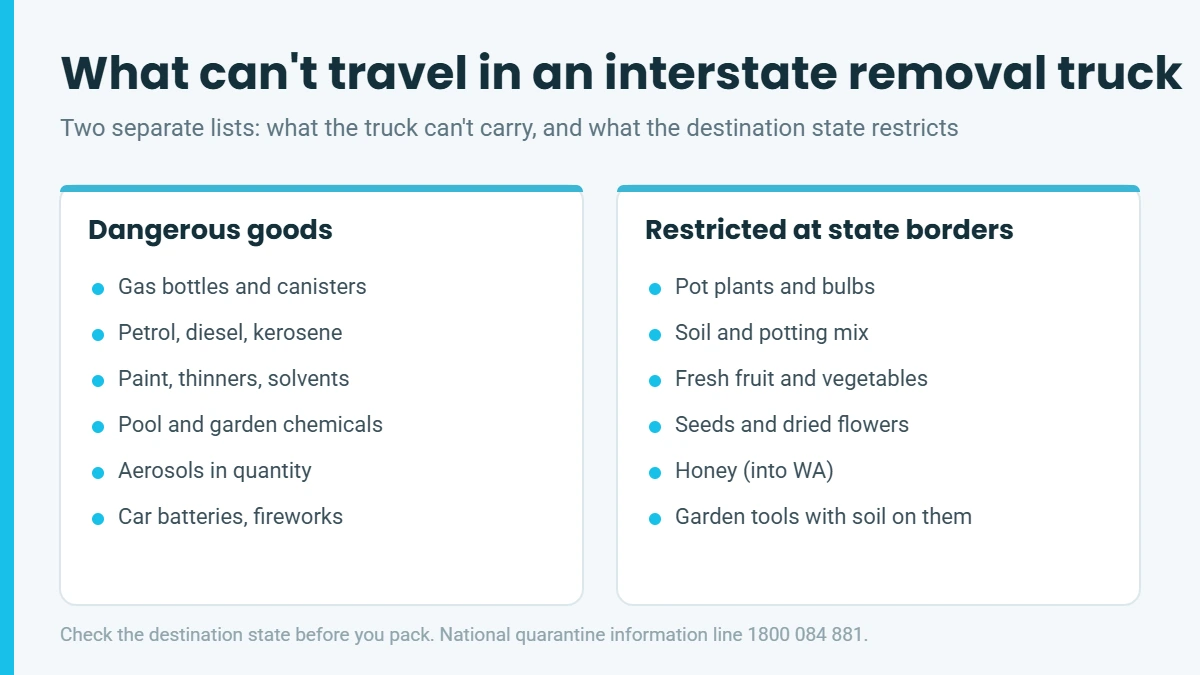
Dangerous goods. Gas bottles, petrol, diesel, kerosene, paint and thinners, aerosols, pool chemicals, pesticides, fireworks and car batteries. These are classified as dangerous goods for road transport and are not carried in a household removal load.
Anything restricted at the destination. Pot plants, soil and potting mix, and fresh fruit and vegetables are controlled at state borders. Western Australia and South Australia are the strictest. Queensland and New South Wales have conditions that depend on the item and where it came from.
Everything else on the usual “don’t pack” list — passports, jewellery, medication, the house keys — isn’t banned. It is simply better in your own car.
Dangerous Goods a Removal Truck Can’t Carry
Dangerous goods are classified nationally under the Australian Dangerous Goods Code, which sets the rules for transporting them by road and rail. A furniture truck packed with household goods isn’t set up or placarded to carry them, so they stay behind.
The items that come up most often in a Melbourne household move:
- Gas cylinders — barbecue bottles, camping canisters and patio heater bottles, including ones you believe are empty
- Fuels — petrol, diesel, kerosene, two-stroke mix, lighter fluid and methylated spirits
- Paint and solvents — leftover tins, turpentine, thinners, paint stripper
- Garden and pool chemicals — weed killer, pesticide concentrate, chlorine, pool acid, fertiliser
- Aerosols in quantity — spray paint, insect spray, lubricant sprays
- Car batteries, fireworks and ammunition
Petrol-powered tools are a separate case. A mower, whipper snipper, generator or chainsaw can usually travel once the fuel tank is drained and run dry, and the fuel itself is disposed of. Drain them a week before the move so they have time to dry out, and tell your removalist they are in the load.
How to Get Rid of Them in Victoria
Victoria has a free disposal service for exactly this problem. Detox Your Home, run by Sustainability Victoria, accepts household chemicals — paint strippers, pool chlorine, pesticides, fuels, oils, aerosols, butane canisters and similar — at free drop-off events across the state. Containers need to be 20 kg or 20 litres or under, and you can attend any event, not only the one your own council hosts.
The events run to a calendar rather than on demand, so check the dates as soon as you know your moving date. For the rest:
- Gas bottles — most swap-and-go sites and some transfer stations take them back
- Car batteries and motor oil — accepted at many council transfer stations
- Usable paint and chemicals — worth offering to neighbours before they become waste
Your own council’s waste page will list what its transfer station takes and what it charges.
Plants, Soil and Produce: the State Border Rules
This is the part people are caught out by, because the rules aren’t about safety — they’re about stopping pests and diseases moving between states.
Pot Plants and Soil
Australian Interstate Quarantine puts it plainly: soil can carry harmful pests and diseases, and most states do not allow pot plants to be moved. Pests and diseases also travel on leaves, so a plant that has been repotted into fresh mix isn’t automatically in the clear.
Where a plant really matters to you, there is sometimes a treatment and certification pathway, but it costs money and takes time, and it has to be arranged before the move rather than at the border.
The same thinking applies to anything carrying soil: garden tools, pots, wheelbarrows, mowers, outdoor furniture with dirt caked on the feet. Clean them down before they go on the truck.
Fruit and Vegetables
Fresh produce is restricted into several states, and the restrictions change with fruit fly outbreaks. The practical approach for a move is to run the fridge and the fruit bowl down in the last week rather than trying to work out which apples are allowed where.
Route by Route
Apex Moving runs interstate moves from Melbourne to Sydney, Brisbane, the Gold Coast, Adelaide and Perth. Here is what each destination is concerned with, and the authority to check with.
| Destination | What to watch | Check with |
|---|---|---|
| Perth, WA | The strictest border. Pot plants and bulbs, dried flowers and potpourri, seeds, fresh produce and honey from the eastern states are all restricted, and used garden tools and mowers can be inspected. | Quarantine WA (DPIRD) |
| Adelaide, SA | Fruit fly controls. What you may bring depends on which state you’re travelling from and which produce it is, and there are disposal bins on the approach roads. | PIRSA fruit fly |
| Brisbane and Gold Coast, QLD | Conditions on plant material, soil and related equipment entering the state, and some items need a biosecurity certificate arranged before they travel. | Business Queensland |
| Sydney, NSW | Movement conditions on pot plants, soil and used gardening equipment that depend on the pest concerned and which part of Victoria you’re leaving. | NSW DPIRD |
Because the detail depends on the plant, the pest and the part of Victoria you are leaving, the sensible step is one phone call rather than an assumption. The national quarantine information line is 1800 084 881, and Agriculture Victoria links through to each state’s biosecurity authority.
What to Carry Yourself Rather Than Send on the Truck
These aren’t banned. They are the things you’ll want in your hand rather than in a container that is days away.
- Passports, birth certificates, visas, wills and title documents
- Jewellery, cash, small valuables and anything irreplaceable
- Prescription medication, and enough of it to cover the gap between pickup and delivery
- Laptops, phones, chargers and hard drives
- Keys, including spares for the old place that have to go back to an agent
- A few days of clothes, toiletries and whatever the children or pets need
An interstate delivery arrives in a window rather than on an exact hour, so pack that bag on the assumption that it may be your only luggage for several days.
Items Worth Raising Before Moving Day
These can usually travel, but they change how the job is planned and priced, so they belong in the quote conversation rather than as a surprise on the day.
- Fridges and freezers — defrost and dry them out 24 hours ahead
- Gas appliances and air conditioners — disconnection is licensed work and needs booking separately
- Safes, pianos, pool tables and gym equipment — weight and access dictate the crew and equipment
- Aquariums — the tank travels empty; fish and water do not travel in the truck
- Firearms and ammunition — handled under their own rules, not as part of a household load
- Pets — travel with you or with a specialist pet transport service
What to Do With the Plants You Can’t Take
Give yourself a few weeks and there are better options than the green bin. Friends and neighbours will usually take healthy plants. Community gardens, schools and local buy-nothing groups are steady takers. Cuttings travel far more easily than whole plants where the destination allows them at all, and a photo of the old garden costs nothing to carry.
Whatever you decide, decide it before packing week. Plants left to the last day become a moving-morning problem.
Fitting This Into the Move
The disposal side takes longer than people expect, mostly because Detox Your Home events run to a calendar and transfer stations keep their own hours. A workable order:
- Four weeks out — walk the shed, garage and laundry and pull out everything on the dangerous goods list
- Three weeks out — book a Detox Your Home event or a transfer station run, and check the destination state’s rules for anything green
- Two weeks out — rehome plants, drain fuel from tools, start running the pantry and freezer down
- The last week — clean soil off tools and outdoor furniture, pack the bag that travels with you
When we quote an interstate move from Melbourne, we ask what is going and what is staying, because the answer changes the truck, the load plan and the price. Telling us early about the shed contents, the piano or the plants is what keeps the quote accurate.
Frequently Asked Questions
Can I take pot plants interstate in Australia?
Usually not. Australian Interstate Quarantine advises that most states do not allow pot plants to be moved, because soil and leaves carry pests and diseases. Some plants can be treated and certified, at a cost, if arranged in advance. Check with the destination state before you plan around it.
Why won’t removalists take gas bottles, even empty ones?
An empty bottle still holds residual gas and vapour, so it is treated the same way as a full one. Gas cylinders are dangerous goods for road transport and don’t travel in a household furniture load.
Can I move my lawn mower interstate?
Generally yes, once the fuel tank is drained and the mower has been run dry, and the deck and wheels have been cleaned of soil and clippings. Western Australia inspects used garden equipment on arrival, so a clean machine saves time at the border.
What happens if I take restricted items across a state border anyway?
Items can be seized and destroyed at the border, and penalties apply. It is not worth the risk for a bag of lemons or a pot plant.
How do I dispose of paint and chemicals before a move in Melbourne?
Sustainability Victoria’s Detox Your Home events take household chemicals free of charge for Victorians, in containers up to 20 kg or 20 litres. Your council’s transfer station is the alternative, and it will publish its own list and fees.
Do these rules apply to backloading as well?
Yes. The same dangerous goods and biosecurity rules apply whether your belongings fill a truck or share one. Backloading changes the timing and the price, not what is allowed on board.
Planning an Interstate Move From Melbourne?
Tell us what is going, where it is going and when, and we will plan the move and send you a written quote. Request a quote online, contact our team or call 0470 515 895. You can also read our guide to removalist costs in Melbourne, see how our packing service works, or browse all our removalist services.